◆ Direct mail targeting for high-value acquisition
Stop mailing everyone. Mail the ones worth mailing.
A targeting model that scores your prospects, ranks who to mail first, and tells you where to stop — so the same mail budget brings you more customers, and better ones.
Built for high-value acquisition: subscription services and big-ticket purchases, where every new customer is worth enough to make smart targeting pay for itself.
What a model is worth, in dollars
A worked example: 100,000 prospect households, $1,000 per sale, $1.50 per piece. The model ranks the file into deciles — and prices out exactly where mailing stops paying.
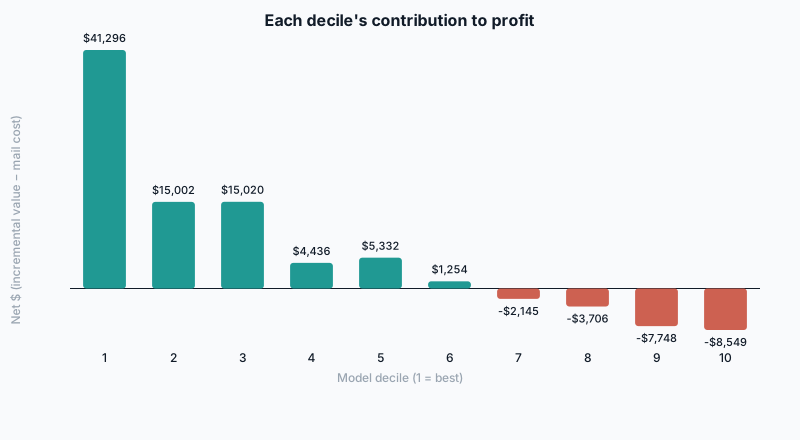
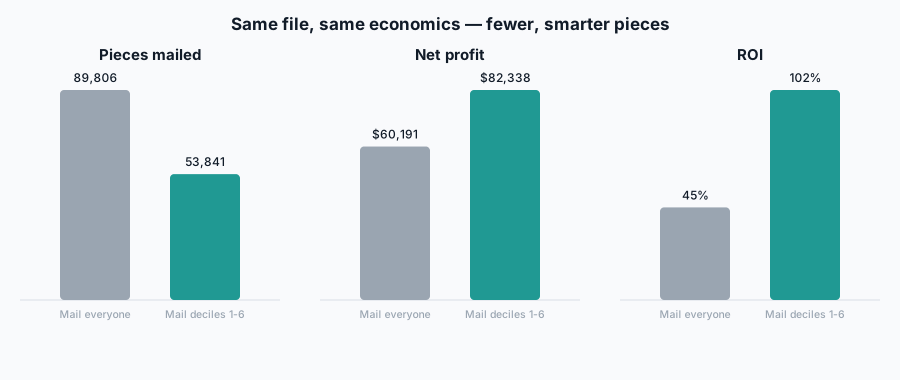
Mailing only the deciles that pay: 40% fewer pieces, $22K more profit, and ROI up from 45% to 102% — on the same file, with the same economics, while keeping 84% of the incremental sales.
See the full write-up, with methodology and reproducible code ↗
See what a model could be worth for your numbers — try the free ROI calculator on the Tools page, plus a sample-size calculator for sizing your holdout. →
Built for high-value acquisition
Subscription services
Telecom, senior living, and similar recurring-revenue offers. Twenty-plus years of my modeling work has been signing people up for exactly these.
Big-ticket purchases
Real estate, auto, and other high-margin, considered decisions, where the response often runs lead → appointment → sale.
If your customers are worth a lot and you reach them by mail, a targeting model earns its keep. If you’re mailing a cheap, low-value offer, it usually won’t — and I’ll tell you so.
What you walk away with
- A scored prospect file — every household ranked by likelihood to convert.
- A mail / no-mail cutoff set by your economics — your cost per piece and your value per customer decide where mailing stops paying.
- Projected lift vs. your current approach — a gains chart and expected response and ROI, so you know what the model is worth before you drop a single piece.
- A plain-English readout you can hand to non-technical decision-makers.
Fixed scope. Fixed formula. A price you know before you start — no hourly meter.
How it works
- Intro conversation: we discuss your mailing, your economics, and the data you have. You’ll know quickly whether a model fits your situation, and roughly what the model would be worth. (No charge)
- Audit: A deeper dive into the details of the data, including sample files or complete data sets, to make sure we have what we need for a successful project. ($750 flat fee, credited toward model build if we proceed)
- Model build: I train the model on who you mailed and who responded. I validate the model based on how well it ranks who converts.
- Output: You get the file of your customers, now with a scored, ranked model score, with a recommended cutoff.
- Mail smarter: Drop the model-selected file through your existing mail house. Nothing about your production changes, just who is on the list.
Typical turnaround from a clean data hand-off:
- Phase 0 audit in 1–2 business days
- Model build in 5–9 business days depending on methodology
- Data that includes a holdout supports building a lift model, which takes 7–9 business days
- Data with no holdout gets a propensity model, which takes 5–7 days
- Total time: 6–11 business days
- Need it faster? Rush delivery is possible. Let’s discuss.
Cost Summary
Fixed prices, no hourly meter. The audit fee is credited toward the model build if you proceed within 30 days.
| Stage | Price | Covers |
|---|---|---|
| Audit | $750 flat | Files up to ~50,000 records; confirms data fit and holdout status |
| Model build | $4,000 flat | Files up to ~50,000 records; propensity scoring or lift/uplift validation — same price either way |
Larger files or multiple campaigns? Contact me for a quote. Want to see the potential payoff first? Try the free ROI calculator on the Tools page →
Keeping it current
| Plan | Base price | 10,000 records | 50,000 records |
|---|---|---|---|
| Quarterly refresh | $1,500 minimum + $0.05/record beyond 10,000 | $1,500 ($0.15/record) | $3,500 ($0.07/record) |
| Annual subscription (4 refreshes, 15% off) | 15% off the sum of 4 quarterly refreshes | $5,100/yr (vs. $6,000 separately) | $11,900/yr (vs. $14,000 separately) |
| Full rebuild | Same as original model build ($4,000) | Recommended annually or after major offer/list changes | |
| Scoring-only add-on (monthly) | $400 minimum + $0.01/record beyond 10,000 | $400/mo ($0.04/record) | $800/mo ($0.016/record) |
Frequently asked questions
How big does my list or history need to be?
It depends on your response rate, sale value, and mail cost — there’s no fixed minimum. Plug your own numbers into the ROI calculator on the Tools page to see exactly where the breakeven falls for your list.
We use a mail house — do you replace them?
No. I build the targeting; your mail house still handles production and the drop. I just change who’s on the list.
How is this different from what my list broker offers?
A broker sells you names. I build a model on your results that ranks those names by who’ll actually convert for your offer — and tells you where to stop mailing.
What counts as a “response” for a big-ticket offer?
Usually the earliest reliable signal — a lead or inquiry — with the economics layered on top to turn scores into expected value. We define it together in scoping.
Can you prove it worked?
Yes — the deliverable includes projected lift up front, and we can design a holdout so you measure the real result after the drop.
Find out if a model fits your program
A short scoping call is free and tells you whether targeting will pay — before you commit to anything.